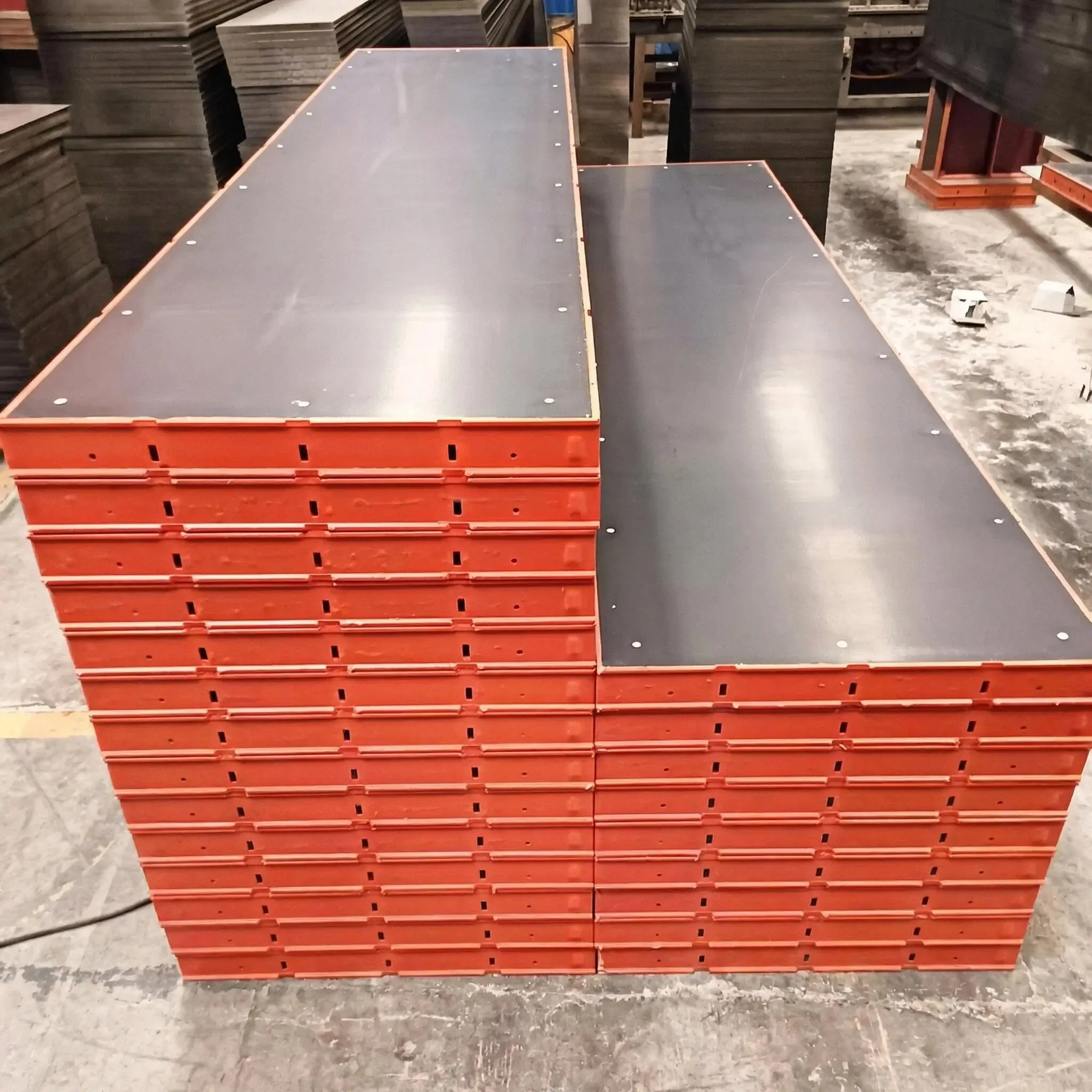
A concrete formwork panel may appear to be a straightforward combination of steel and plywood, but its performance depends heavily on how those materials are processed and assembled. For contractors, distributors, and project procurement teams, evaluating China steel frame formwork means looking beyond the finished panel. Welding quality, dimensional consistency, surface treatment, plywood selection, customization, and quality control all influence how reliably the system performs on site.
Why the Factory Matters for Steel Plywood Formwork
Steel-frame formwork combines a rigid structural frame with a plywood facing that contacts fresh concrete. This arrangement is widely used for wall and column applications because it can provide a reusable forming solution while maintaining relatively consistent panel dimensions. Commercial framed systems also demonstrate how steel frames and plywood sheets can be engineered together for repeated concrete work.
Factory capability matters because these two materials must work as one system. A strong frame cannot compensate for unsuitable facing material, while good plywood cannot overcome poor welding or inaccurate assembly. For business buyers, manufacturing control is therefore part of the product specification, even when it is not visible after delivery.
Steel Processing Builds the Structural Frame
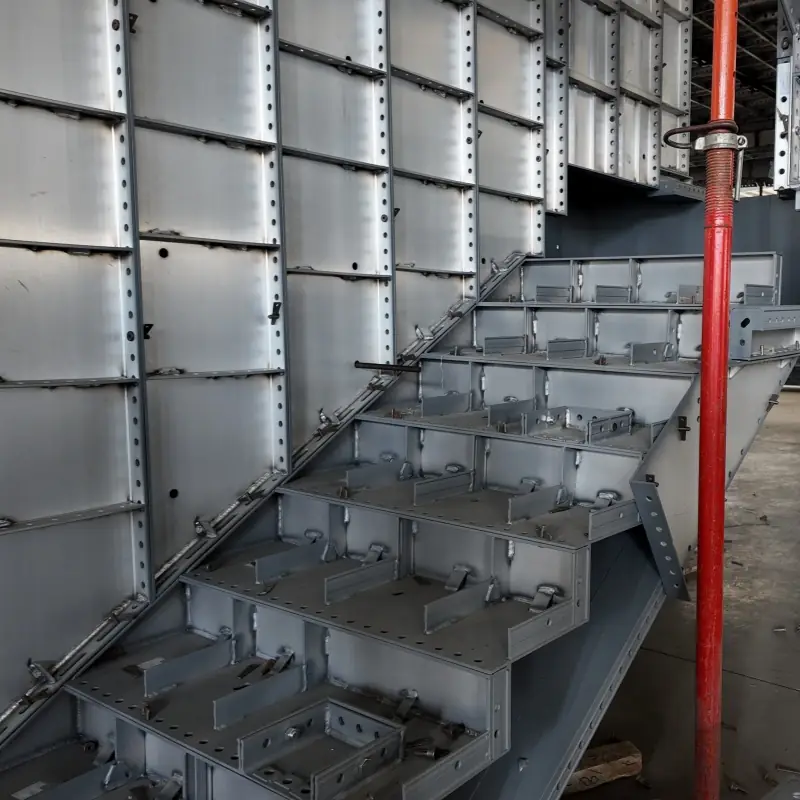
The steel frame provides the backbone of the panel. Manufacturing starts with cutting and preparing steel profiles, followed by forming, positioning, and welding the frame and its supporting members. Dimensional accuracy at these stages affects how panels align when they are assembled on site.
Welding deserves particular attention because inconsistent joints can affect rigidity and dimensional stability. Established framed-formwork products commonly use strong steel profiles and cross-profiles to maintain panel shape under construction conditions. Doka, for example, describes dimensionally stable steel hollow profiles and strong cross-profiles as features of its framed systems.
For us, factory control means treating welding and frame assembly as key production stages rather than simply completing them as routine fabrication work. Consistent positioning, welding, inspection, and finishing help us maintain repeatable panel quality across production batches.
Plywood Selection Affects the Concrete Face
The plywood facing is the part of steel ply concrete forms that directly contacts fresh concrete, so its quality has a direct relationship with the finished surface. Different plywood types, thicknesses, coatings, and wood species can provide different combinations of surface quality, durability, and reuse potential.
Professional formwork manufacturers offer plywood specifically selected for concrete applications. Doka, for example, lists birch, spruce, eucalyptus, and other plywood options with different coatings and construction characteristics for different forming requirements.
We therefore treat the plywood panel as an important part of the overall system rather than an interchangeable sheet. Buyers requiring a particular concrete finish or project-specific configuration should clarify facing requirements before production begins.
Surface Treatment Protects the Steel Frame
Steel formwork is repeatedly exposed to moisture, concrete residue, handling, and outdoor storage. Surface treatment can therefore influence the frame’s resistance to corrosion and its ease of maintenance.
Powder coating and galvanizing are both used across commercial formwork systems. Doka, for example, identifies powder coating as a way to protect framed panels against corrosion and make cleaning easier, while other framed systems use galvanized steel profiles for long-term protection.
Our production approach can incorporate surface-treatment options according to project requirements. For buyers, the important question is not simply whether a panel has been coated, but whether the selected treatment is suitable for its intended environment, handling conditions, and expected reuse.
Dimensional Control Supports Faster Site Assembly
Factory accuracy becomes especially valuable when multiple panels must be combined on a construction site. Consistent dimensions help panels align properly and reduce unnecessary adjustments during erection.
Formwork systems commonly use standardized panel grids and connection arrangements to make setup more efficient. Doka’s framed formwork, for example, uses defined panel dimensions and tie-hole arrangements to support systematic assembly.
For project buyers, this highlights an important distinction between a fabricated panel and a manufactured formwork system. The latter requires consistency from one panel to another so that components can be combined predictably throughout a project.
Customization Is Another Factory Capability
Construction projects rarely have identical requirements. Wall thicknesses, panel dimensions, forming layouts, handling methods, and concrete surface expectations can vary considerably. Factory customization can therefore be valuable when standard panels do not fit a project’s forming plan.
We supply reusable steel plywood formwork for walls, columns, slabs, and beams, with customized panel sizes, surface-treatment options, and OEM services available for different project requirements. Our products are supplied to customers across Southeast Asia, the Middle East, Africa, Europe, and South America.
This capability allows us to work around project-specific requirements rather than forcing every application into one standard configuration. For distributors, customization can also make it easier to develop formwork packages for different regional markets.
What Should Buyers Evaluate Before Ordering?
When comparing China steel frame formwork, buyers should assess more than the quoted unit price. A practical evaluation can include steel-frame construction, welding consistency, plywood quality, dimensional tolerances, surface treatment, connection compatibility, customization capability, inspection procedures, packaging, and production capacity.
The same principle applies when comparing steel ply concrete forms from different suppliers. A lower initial price may have limited value if inconsistent dimensions, poor surface protection, or unsuitable plywood increase adjustment, maintenance, or replacement requirements during use.
Factory Capability Is Part of the Product
The performance of steel plywood formwork begins long before panels reach a construction site. Steel preparation, precision welding, plywood selection, surface treatment, dimensional control, and inspection all contribute to the finished system.
We at Rongze combine steel frames with quality plywood panels to provide reusable formwork solutions for different concrete construction applications. For contractors, distributors, and project buyers, our focus is not simply supplying panels, but supporting practical formwork requirements through manufacturing, customization, and quality control. That factory capability is what turns raw steel and plywood into a dependable forming solution.